Trump Shares Image of ‘VETO’ Cap in Preparation to Fight Democrats After Midterm Wins
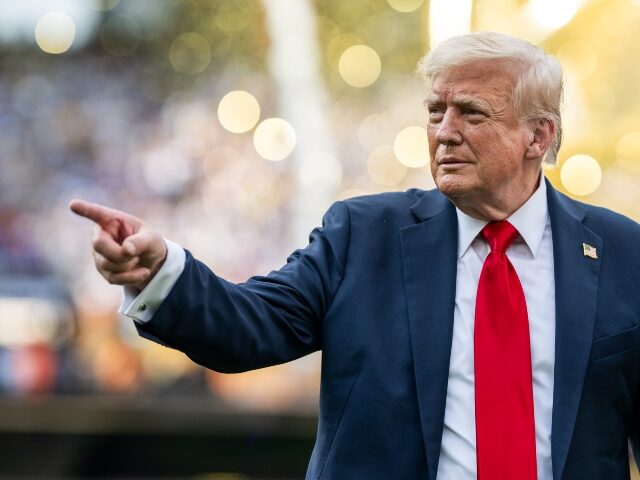
President Donald Trump is standing firm against the Democrats who were projected to take the U.S. House and U.S. Senate as the midterm elections came to a close on Tuesday evening.
In a Truth Social post, Trump shared a photo of a red baseball cap with the word “VETO” stitched on the front:https://www.breitbart.com/t/assets/html/tweet-5.html#2117840115301232900
His message came after he recently said he planned to become “Mr. Veto” if the Democrats successfully took the majority, Breitbart News reported Monday.
“Well, if that happens, I guess I’ll become Mr. Veto,” he said, adding, “And then at some point, we’ll probably make deals. That’s what’s happened. I mean, this is — this wouldn’t be the first time you’ll have a president, and he won’t have the House or the Senate. They’ll be sending stuff up. You veto it, and eventually, after a month or two of getting all vetoed, you know … they come over, and you make a deal.”
DONALD TRUMP JUST DROPPED: “VETO” Time for a FIREWALL of COMMON SENSE for the next 2 years. They can’t pass anything without Trump’s signature!

Captain Convey Comment
Maybe him can makum deal not to be impeachum?
____________________________________________________
The constitutional rule
The veto override power comes from Article I, Section 7. The Constitution sets up a sequence: Congress passes a bill, the President responds, and if the President vetoes, Congress gets a second chance under a supermajority rule.
Here is the key language (paraphrased): if the President returns a bill with objections, the originating chamber must reconsider it, and if two-thirds agree to pass it again, it goes to the other chamber, which must also repass it by two-thirds. If both chambers hit that threshold, the bill becomes law anyway.
Requirement: Two-thirds vote in the House and two-thirds vote in the Senate
Two-thirds of what: Two-thirds of those present (assuming a quorum), not two-thirds of all members
Public record: The vote must be by yeas and nays and entered in each chamber’s journal
Effect: The bill becomes law over the President’s veto
Step by step
- Congress passes a bill
A bill must pass the House and Senate in identical form. Then it is presented to the President. - The President responds
From there, the Constitution gives the President three basic pathways:
Sign it: The bill becomes law.
Return it with objections (a regular veto): The bill goes back to the chamber where it originated, triggering the override process described below.
Take no action: If Congress remains in session, the bill becomes law after 10 days (excluding Sundays) without a signature. If Congress adjourns in a way that prevents return, the result can be a pocket veto (explained later).
3) A regular veto is returned with objections
A veto is not just “no.” Constitutionally, it is the President returning the bill to Congress with objections. That return matters because it triggers the override process.
In practice, the veto message is delivered back to the chamber where the bill originated and entered into the official record.
4) The originating chamber reconsiders first
Article I, Section 7 sends the bill back to where it started. If the House originated the bill, the House votes first. If the Senate originated it, the Senate votes first.
This is not a fresh, open-ended rewrite. The override vote is about whether to pass the same bill again, despite the veto.
- Two-thirds is calculated from those present
The threshold is two-thirds of the members present, assuming a quorum is present. This detail is one of the most misunderstood parts of the process.
If 435 House seats exist but 420 members are present, the two-thirds threshold is calculated from 420, not from 435.
If 100 Senate seats exist but 96 senators are present, the two-thirds threshold is calculated from 96, not from 100.
Also note the practical nuance: “present” is about who is in the chamber, not just who votes yes or no. Members can be present and vote “present” or abstain, and since the denominator is those present, attendance itself can change the math.
- Both chambers must reach the threshold
If the originating chamber reaches two-thirds, the bill moves to the other chamber for reconsideration. The second chamber must also reach two-thirds of those present. One chamber cannot override alone.
If both chambers succeed, the veto is overridden and the bill becomes law without the President’s signature.
Two-thirds: common mistakes
Misconception 1: “A simple majority can override a veto”
No. A veto is one of the Constitution’s built-in advantages for the executive branch, and the override rule is designed to be hard. A bill that squeaks through Congress with thin margins is usually dead once vetoed.
Misconception 2: “It takes two-thirds of the entire House and Senate”
Not exactly. The Constitution uses the standard of two-thirds of those present in each chamber, assuming a quorum is present. That means absences and “present” votes can change the denominator.
This is also why you will sometimes see intense pressure campaigns around attendance for major votes. Being absent is not neutral. It changes the math.
Misconception 3: “If Congress has two-thirds in one chamber, the veto is basically meaningless”
Also no. The override requires two separate supermajorities, often under different political incentives and different electoral pressures. In modern politics, assembling two-thirds in both chambers is rare, and presidents know that.
Misconception 4: “The President can veto parts of a bill”
At the federal level, the President generally must accept or reject a bill as a whole. The Constitution does not give the President a general line-item veto for ordinary legislation. If the President objects to specific provisions, the formal tool is still a veto of the entire bill, with objections sent back to Congress.
Pocket veto
The override process depends on the bill being returned to Congress with objections. A pocket veto happens when the President does not sign a bill and Congress adjourns in a way that prevents return.
Captain Convey Bonus Comment
Two-thirds is calculated from those present.
The threshold is two-thirds of the members present, assuming a quorum is present.
Quorum Requirements in Congress
A quorum is the minimum number of members required to be present for Congress to conduct its business.
House of Representatives
Total Members: 435
Quorum Requirement: 218 members must be present.
Senate
Total Members: 100
Quorum Requirement: 51 senators must be present.
So there must be at least 218 reps in the house to vote on a veto overide.
There must be 51 senators to be in senate to vote on a veto overide.
So 146 reps would need to vote to override a veto if 218 were present. Minimum.
34 senators out of 51 senators present would need to vote to override a veto. Minimum.
For those of you in Reo Linda, as Rush Limbaugh use to say,
Impeachment Process in the House of Representatives
Quorum Requirement
A quorum is necessary for the House of Representatives to conduct any business, including impeachment votes. This means that a majority of the members must be present during the vote.
Impeachment Vote
Simple Majority: To impeach a president, the House requires a simple majority vote of those present, not a quorum vote.
Conducting Business: While a quorum must be present for the House to vote, the actual impeachment decision is based on the majority of those voting.
Summary
In summary, while a quorum is needed for the House to operate and vote, the impeachment itself only requires a simple majority of those present and voting.
So 110 reps would need to vote to override a veto if 218 were present. Minimum.
109 is a tie. 110 is a simple majority out of 218 present.
So 109 Reps min is required to impreach a president.
US Senate
2/3 of senators present must vote on an article of impeachment to convict and remove a president.
There must be 51 senators voting on on an article of impreachment from the house of reps to remove a president from office. 2/3 present. If 51 are present thats 34 voting to remove out of 51 present. Minimum.
Also the US Senate could just refuse to vote on a article of impeachment from the house.
So the president would not be removed.
The US house of reps can impeach out the yengyang but if the uS senate doesn’t vote with a majority on an article of impeachment or just ignores the house article of impeachment the president is not removed from office.
I suspect the house will turn out articles of impeachment quicker that you can get your first class mail delivered – up to a week!
A scum circus congress starts in Jan 2027.
Democrate majority.