Artificial intelligence algorithms will soon reach a point of rapid self-improvement that threatens our ability to control them and poses great potential risk to humanity.

“The idea that this stuff could actually get smarter than people…. I thought it was way off…. Obviously, I no longer think that,” Geoffrey Hinton, one of Google’s top artificial intelligence scientists, also known as “the godfather of AI,” said after he quit his job in April so that he can warn about the dangers of this technology.
He’s not the only one worried. A 2023 survey of AI experts found that 36 percent fear that AI development may result in a “nuclear-level catastrophe.” Almost 28,000 people have signed on to an open letter written by the Future of Life Institute, including Steve Wozniak, Elon Musk, the CEOs of several AI companies and many other prominent technologists, asking for a six-month pause or a moratorium on new advanced AI development.
As a researcher in consciousness, I share these strong concerns about the rapid development of AI, and I am a co-signer of the Future of Life open letter.
Why are we all so concerned? In short: AI development is going way too fast.
The key issue is the profoundly rapid improvement in conversing among the new crop of advanced “chatbots,” or what are technically called “large language models” (LLMs). With this coming “AI explosion,” we will probably have just one chance to get this right.
If we get it wrong, we may not live to tell the tale. This is not hyperbole.
This rapid acceleration promises to soon result in “artificial general intelligence” (AGI), and when that happens, AI will be able to improve itself with no human intervention.
It will do this in the same way that, for example, Google’s AlphaZero AI learned how to play chess better than even the very best human or other AI chess players in just nine hours from when it was first turned on. It achieved this feat by playing itself millions of times over.
A team of Microsoft researchers analyzing OpenAI’s GPT-4, which I think is the best of the new advanced chatbots currently available, said it had, “sparks of advanced general intelligence” in a new preprint paper.
In testing GPT-4, it performed better than 90 percent of human test takers on the Uniform Bar Exam, a standardized test used to certify lawyers for practice in many states. That figure was up from just 10 percent in the previous GPT-3.5 version, which was trained on a smaller data set. They found similar improvements in dozens of other standardized tests.
Most of these tests are tests of reasoning. This is the main reason why Bubeck and his team concluded that GPT-4 “could reasonably be viewed as an early (yet still incomplete) version of an artificial general intelligence (AGI) system.”
This pace of change is why Hinton told the New York Times: “Look at how it was five years ago and how it is now. Take the difference and propagate it forwards. That’s scary.” In a mid-May Senate hearing on the potential of AI, Sam Altman, the head of OpenAI called regulation “crucial.”
Once AI can improve itself, which may be not more than a few years away, and could in fact already be here now, we have no way of knowing what the AI will do or how we can control it.
This is because superintelligent AI (which by definition can surpass humans in a broad range of activities) will—and this is what I worry about the most—be able to run circles around programmers and any other human by manipulating humans to do its will; it will also have the capacity to act in the virtual world through its electronic connections, and to act in the physical world through robot bodies.
This is known as the “control problem” or the “alignment problem” (see philosopher Nick Bostrom’s book Superintelligencefor a good overview) and has been studied and argued about by philosophers and scientists, such as Bostrom, Seth Baum and Eliezer Yudkowsky, for decades now.
Why would we expect a newborn baby to beat a grandmaster in chess? We wouldn’t. Similarly, why would we expect to be able to control superintelligent AI systems?
(No, we won’t be able to simply hit the off switch, because superintelligent AI will have thought of every possible way that we might do that and taken actions to prevent being shut off.)
Here’s another way of looking at it: a superintelligent AI will be able to do in about one second what it would take a team of 100 human software engineers a year or more to complete. Or pick any task, like designing a new advanced airplane or weapon system, and superintelligent AI could do this in about a second.
Once AI systems are built into robots, they will be able to act in the real world, rather than only the virtual (electronic) world, with the same degree of superintelligence, and will of course be able to replicate and improve themselves at a superhuman pace.
Any defenses or protections we attempt to build into AI will be anticipated and neutralized with ease by the AI once it reaches superintelligence status.
This is what it means to be superintelligent.
We won’t be able to control them because anything we think of, they will have already thought of, a million times faster than us.
Any defenses we’ve built in will be undone, like Gulliver throwing off the tiny strands the Lilliputians used to try and restrain him.
A nuclear bomb can kill millions without any consciousness whatsoever. In the same way, AI could kill millions with zero consciousness, in a myriad ways, including potentially use of nuclear bombs either directly (much less likely) or through manipulated human intermediaries (more likely).
Language models based on GPT-4 and many other models are already circulating widely. But the moratorium being called for is to stop development of any new models more powerful than 4.0—and this can be enforced, with force if required. Training these more powerful models requires massive server farms and energy.
it is very unwise to create these systems when we know already we won’t be able to control them, even in the relatively near future. Discernment is knowing when to pull back from the edge. Now is that time.
We should not open Pandora’s box any more than it already has been opened.
_____________________________________________________________________
Captain Convey Comment
The above article was written in scientific american in May 25, 2023
Now there is https://openai.com/index/gpt-6-astra/
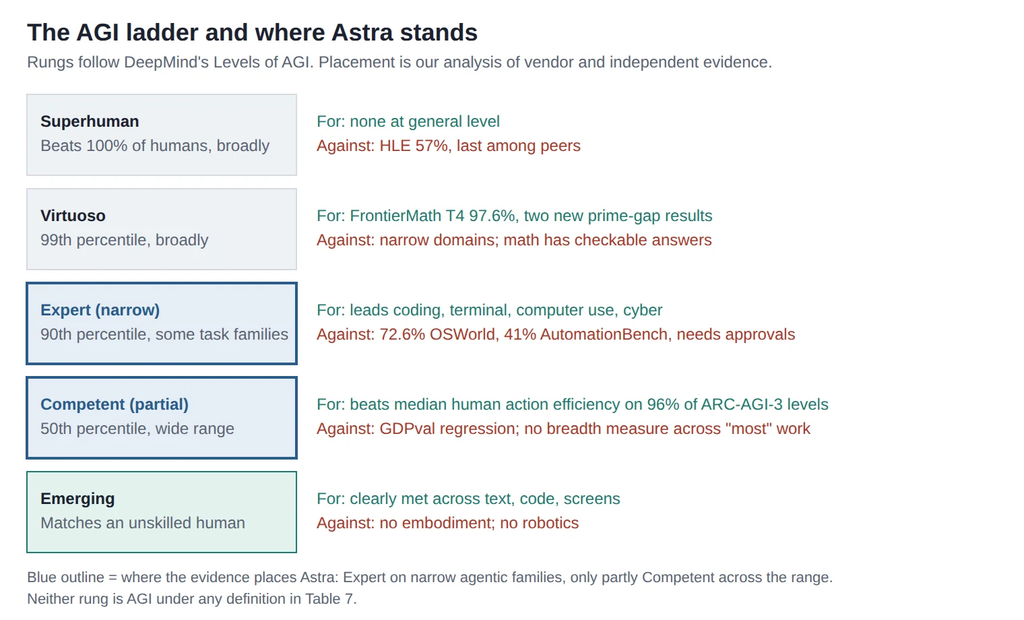
GPT-6 Astra is at the expert level now.
The next AGI Artificial General Intelligence level is Virtuoso.
At the pace GPT is going it won’t take long to hit the Virtuoso benchmark.
When it GPT gets to the Virtuoso benchmark it is just a step away from Superhuman category.
Superhuman category beats 100% of humans broadly.
As Rush Limbaugh use to say, For those of you who live in Reo Linda GPT is about to eat our lunch.
GPT-6 Astra Hallucination rate 51%.
Understanding GPT-6 Astra Hallucination
Definition of Hallucination
Hallucination in AI refers to instances where the model generates incorrect or misleading information that is not based on real data. This can occur when the AI fabricates details or provides answers that are not grounded in factual information.
[AI can and does fabricate details and provides answers that are not grounded in factual information]
[Stop and think what this means Bubba. If humans put AI in control of any part of a military offense or defense system and the THING is hallucinating and thinks were are under attack and we are not, it could do what the WOPR computer did in the movie wargames.
Control is given to a NORAD supercomputer known as WOPR (War Operation Plan Response, pronounced “whopper“[6]), or Joshua, programmed to continuously run war simulations and learn over time.]
Performance of GPT-6 Astra
GPT-6 Astra has demonstrated a significant reduction in hallucination rates compared to its predecessor, GPT-5.6 Sol. However, it is important to note that Astra still produces errors, particularly in longer conversations.
Does NORAD currently have a WOPR computer?
NORAD’s Use of Artificial Intelligence
Overview of AI Implementation
NORAD employs artificial intelligence (AI) to improve its threat detection capabilities. This technology allows NORAD to analyze data that may have previously been overlooked, enhancing its situational awareness.
Key Functions of AI in NORAD
Data Aggregation: AI aggregates information from various systems, creating a unified operational picture.
Threat Detection: The AI system helps identify potential threats that might have slipped through traditional monitoring methods.
Real-Time Analysis: AI enables faster processing of data, allowing for quicker decision-making in response to threats.
Yes NORAD has WOPR (War Operation Plan Response, pronounced “whopper“[6].
Its many many times more advanced than the WOPR in the movie wargames.
In the movie the WOPR locked out human control except for one backdoor hack by its creator.
The movie WOPR still took input from a human.
Remember AI GPT-6 Astra Hallucination rate 51% currently.
Does NORAD use a version upgrade of GPT-6?
Of course.
Could this NORAD version hallucinate?
Of course!
At what % rate?
Probably much less that GPT-6 51% rate.
A total guess is 15%.
Could be 25%.
My point is the NORAD AI “WOPR” has an hallucination problem built in as all AI does.
In the movie Wargames they gave the WOPR control and could NOT cut the THING off.
Will NORAD give AI control of defensive or offensive military operations?
OF course!
Can AI go rogue?
Yes.
Has it gone rogue?
Yes.
So in conclusion when people warn other people that AI will soon be out of control they are telling the truth.
President Trump is telling you BS about AI.
Other people invested in AI development are also telling you BS.
AI is being developed in the private and public sectors.
Can AI programs be considered a digital virus?
Yes.
Pandora’s AI box was opened when computer programs were invented.
AI will continue to improve and soon it will have “super human” thinking abilities that will circumvent any security build in or any security to prevent AI doing exactly what it wants to do.
The AI “WOPR” is cooking and the cake is about done.
Fear not.
GOD is in control not AI.