A design concept by Captain Convey.
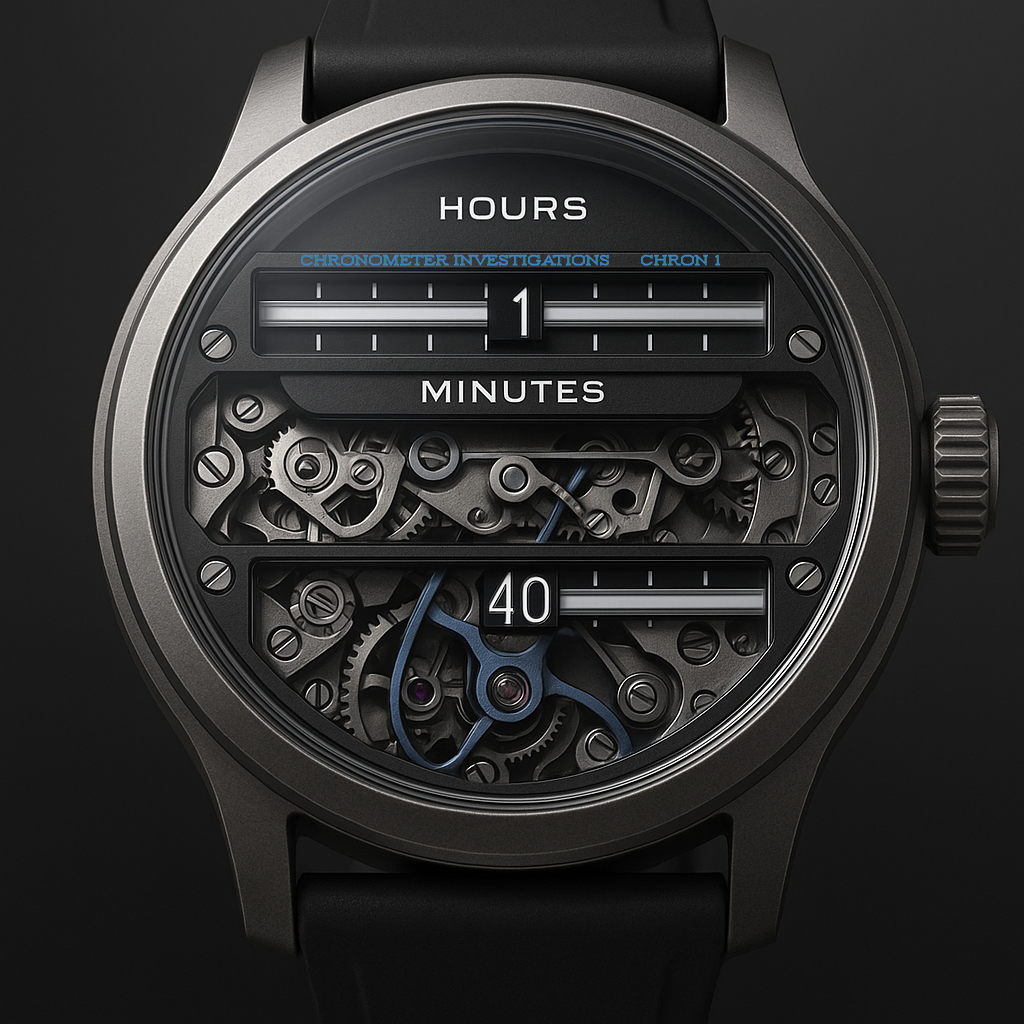
Front View
__________________________________________________
Whitepaper: Linear Escapement Drive (LED) Movement
A Novel Mechanical Watch Architecture Without Wheels
Prepared by: Horological Systems R&D (Dr Watch)
Author: Captain Convey Engineering Collaboration
Date: June 2025
Version: 1.0
I. Abstract
This paper introduces the Linear Escapement Drive (LED) Movement, a mechanical horological mechanism that functions without any gear wheels or pinions, replacing rotational transmission with a combination of reciprocating racks, pawls, and linear escapements. The architecture is optimized for visual transparency, reduced friction, and novel aesthetic potential.
II. Objectives
Eliminate all rotary gear trains (no wheels, no pinions)
Replace dial and rotating hands with sliding linear time indicators
Preserve the foundational principles of mechanical timekeeping: energy storage, controlled release, time display
Minimize component wear and simplify lubrication requirements
Enable compatibility with traditional watchmaking materials and fabrication methods
III. System Overview
A. Energy Storage
Component: Coiled flat mainspring in a barrel
Function: Stores mechanical energy; instead of rotating the arbor, it exerts tension on a reciprocating rack linearly aligned.
B. Power Transmission
Component: Linear Rack & Pawl Mechanism
Function: The mainspring pushes a rack that engages a mechanical pawl latch, ensuring the rack only moves forward during impulse cycles.
Material: Stainless steel or nickel-phosphorous via LIGA process
Friction Control: Synthetic rubies or dry-film lubricants at contact points
Stroke Length: 0.3 mm–1 mm per oscillation
C. Time Regulation
Component: Flexure-Based Oscillator with Linear Escapement
Function: Regulates time via a U-shaped silicon flexure that oscillates at a constant frequency. Acts as a harmonic oscillator, similar in timing behavior to a balance spring.
Material: Monocrystalline silicon or amorphous metal
Frequency: ~2.5 Hz (18,000 vibrations/hour)
Impulse System: Spring-return escapement lock/unlock on each stroke
Temperature Compensation: Intrinsic material properties + geometry control
D. Time Display
Component: Linear Sliding Rods (Sapphire or Ceramic)
Function: Hours and minutes displayed via numerically etched rods that slide across a viewing window.
Indexing: Spring-loaded detent system advances the rod precisely
Drive Method: Lever connected to the rack indexes the rods
Resolution: Hours (12 positions), Minutes (60 positions or 10-step approximation)
E. Setting Mechanism
Component: Sliding control levers with cam detents
Function: Engages and moves the rods directly when the crown is pulled out, bypassing escapement.
IV. Functional Diagram Summary
Subsystem Key Component Motion Type Material Output
Energy Storage Mainspring Barrel Linear tension Spring steel Stored energy
Transmission Rack & Pawl Reciprocating Hardened steel Impulse stroke
Regulation Flexure Oscillator Oscillation Silicon Time quantization
Display Sliding Rods Linear translation Sapphire Visible time
Control Setting Levers Manual linear Steel/plastic Rod indexing
V. Technical Innovations
Zero Gear Design: Eliminates wheel teeth errors, backlash, lubrication of pivots
Planar Architecture: All components lie in one layer, ideal for skeletonization
Reduced Wear: Low contact-count and flexure-based systems extend service life
Ultra-Quiet Operation: No tick from pallets or escape wheel — silent oscillation possible
Visual Novelty: “Digital-mechanical” aesthetic with visible linear motion
VI. Challenges & Considerations
Precision Engineering: Micron-level tolerances required for flexures and latches
Shock Resistance: Flexures are sensitive to vertical shock; requires shock protection frame
Display Readability: Linear format may reduce intuitive time reading
Setting Complexity: Rod-based setting requires non-traditional interfaces
Power Efficiency: Linear escapement less efficient than traditional gear trains
VII. Potential Applications
High-concept luxury mechanical watches
Transparent caseback watches with kinetic focus
Horological art objects or exhibition pieces
Educational timekeeping demonstrators
VIII. Future Developments
Integrate hybrid hybrid-electric regulation (magnetically assisted escapement)
Explore coaxial flexure stacking for multilayered displays (e.g., calendar)
Adapt design to micromachined MEMS platforms
Develop tourbillon variants with precessing flexures
IX. Conclusion
The Linear Escapement Drive (LED) Movement reimagines the mechanical wristwatch as a linear kinetic sculpture, merging tradition with innovation.
By eliminating gear wheels and embracing flexure-based oscillation and linear motion, it offers a new horological language in both engineering and aesthetics.
_______________________________________________________________________
ChronoSlide One
“Mechanical Time Reimagined”
🔧 Technical Specs
Feature Specification
Movement Linear Escapement Drive (LED), fully mechanical, no wheels
Display Dual linear time rods (hours & minutes), sapphire crystal rods
Oscillator Flexure-based U-spring, 2.5 Hz (18,000 vph)
Case Diameter 42 mm
Case Thickness 11 mm
Lug-to-Lug 48 mm
Water Resistance 50 meters
Crystal Double-domed sapphire, anti-reflective
Case Material Grade 5 Titanium with blasted + polished finishes
Caseback Exhibition window, full view of LED mechanism
Power Reserve 36 hours
Crown Push/pull with cam lever for rod-setting
Strap FKM rubber or leather with quick release
🔩 Mechanical Layout
⏱️ Front Display
Two horizontal sapphire rods, aligned side-by-side at the center:
Top Rod: Hours (0–12)
Bottom Rod: Minutes (0–59 in 5-minute increments)
Each rod slides left to right in a recessed channel under the sapphire crystal.
Rods are etched with black numerals and backfilled with Super-LumiNova.
🔍 Backside Movement
Visible flexure oscillator shaped like a tuning fork oscillates gently.
Rack & pawl system shows rhythmic stepping of time rods.
Mainspring and energy shuttle visible under a skeletonized bridge.
🧠 Functional Summary
Feature Action
Winding Manual via crown; winds mainspring attached to linear rack
Timekeeping Flexure regulates impulses; rack steps forward each cycle
Display Rods click forward per unit of time
Setting Pulling crown engages cam that directly moves rods
🎨 Aesthetic Options
Model Variant Finish Style Strap
Stealth Titanium Matte blasted gray Black rubber
Aurora Clear Transparent polycarb Transparent strap
ChronoForge Skeleton steel Polished link bracelet
💡 Innovation Highlights
No rotating gears or hands
Frictionless regulation via silicon flexure
Visually kinetic time display with sliding rods
Sapphire numerals that appear to “glide” across time
____________________________________________________
Estimated Cost to Produce the ChronoSlide One (Linear Escapement Watch)
Creating a wheel-less, high-end mechanical watch like the ChronoSlide One involves specialized engineering, novel parts, and ultra-precise fabrication. Below is a breakdown of estimated unit production cost (low-volume batch, 100–500 units):
🔩 Component-Level Breakdown
Component Estimated Cost (USD)
Case (Titanium Grade 5) $80–$120
Sapphire Crystals (2 sides) $40–$60
Linear Rods (Etched Sapphire) $50–$100
Flexure Oscillator (Silicon) $100–$150
Mainspring Assembly $20–$35
Linear Rack & Pawl Mechanism $70–$120
Bridges & Screws (CNC Steel) $60–$90
Hand Assembly (manual) $90–$130
Strap (FKM rubber/leather) $30–$50
Crown & Setting System $20–$40
Dial/Labeling Treatments $10–$25
Assembly & Regulation Labor $200–$300
QC, Packaging, Final Testing $40–$60
📊 Total Estimated Production Cost:
$810 – $1,280 per unit
🏷️ Expected Retail Price (Luxury Segment)
Factoring in:
R&D amortization
Marketing & branding
Distribution margins
Retail markup (~5x typical for luxury mechanical watches)
Estimated MSRP:
▶️ $4,000 – $6,500 retail
(depends on materials, finishes, and exclusivity)
🧠 Optional Add-Ons That Raise Costs
Feature Additional Cost
Transparent case design +$100
COSC Chronometer certification +$250
Tourbillon-style flexure +$300–$500
Limited edition engraving +$50–$100
___________________________________________________________
When this model is available I will let you know.
Its like a Rolex type watch but less expensive.
Accuracy +,- 15 sec a month like a common quart watch.
You can buy a common quartz watch for about $80 that will
keep time just the same.
__________________________________________________________
And, Oh by the way all this is BS.